Swim Pull Drill
An arms-only freestyle drill that isolates the catch and pull so the underwater stroke can be rebuilt.
How to do it
- Push off in a streamlined position with the legs quiet and the body long.
- Enter one hand about shoulder-width apart, moving forward and slightly down, with the palm flat.
- Set the catch by dropping the hand down and in while the elbow bends and points out to the side.
- Press the hand and forearm straight backward as one surface, accelerating as the hand passes under you.
- Finish the stroke just past the hip, thinking back and up rather than pulling straight through.
- Recover the arm forward while the other side repeats the same sequence, keeping the legs still.
Key technique cue
Elbow above the hand, press straight back — not sideways.
Common mistakes
- ✕ Entering the hand too wide or too narrow, which compromises every phase that follows.
- ✕ Rushing the catch and overpowering it, so the arm never gets oriented backward for the pull.
- ✕ Sculling side to side instead of pressing straight back, which moves water sideways rather than behind you.
- ✕ Dropping the elbow below the hand, a position linked to painful shoulders in competitive swimmers.
Benefits
- ✓ Isolates the catch and pull so hand path and elbow position can be corrected without leg compensation.
- ✓ Loads the main propulsive muscles of freestyle, which contribute the majority of forward force.
- ✓ Builds upper-body endurance in a non-impact environment with no external load.
Progression: from easier to harder
-
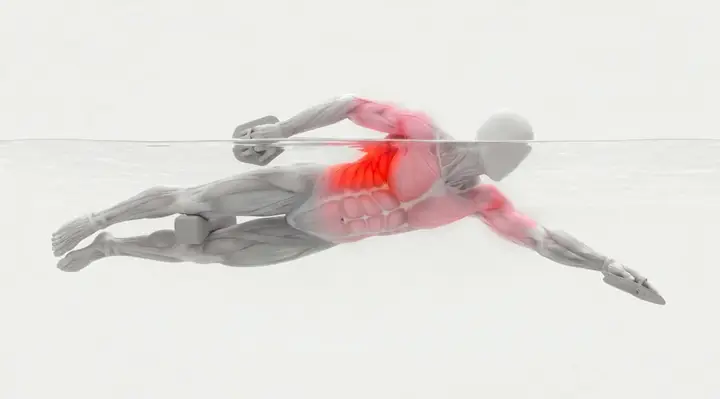 Step 1 You are here
- Swim Pull Drill
- Swim Kick Drill
About the exercise
A pull drill removes the legs so the underwater arm stroke can be worked on its own. The hand enters about shoulder-width and slightly downward, then the catch drops the hand down and in while the elbow bends and points out to the side. From there the pull presses a large surface straight backward with increasing hand speed, and the hand exits just past the hip. The muscles follow that sequence. Early pull-through is driven by pectoralis major, and late pull-through brings latissimus dorsi in to extend the shoulder. Pectoralis major, latissimus dorsi and teres major are the main force producers across this phase.
Updated
A week of training and meals built for you
Workoutify plans workouts around your days, time and equipment — and a menu for your goal and macros.