Band External Rotation
A banded rotator cuff drill that turns the forearm outward with the elbow pinned to the ribs, isolating the external rotators.
How to do it
- Anchor a resistance band at about elbow height and stand side on to the anchor.
- Take the band in the hand furthest from the anchor and tuck that elbow against your ribs.
- Bend the working elbow to ninety degrees and set the shoulder blade down and back.
- Brace your trunk and rotate the forearm outward, away from your midline, without moving the elbow.
- Pause for one second at the end range where the back of the shoulder is working.
- Return the hand slowly against band tension, then repeat and switch arms.
Key technique cue
Elbow glued to the ribs, rotate only the forearm; return slowly.
Common mistakes
- ✕ Letting the elbow drift off the ribs, which turns the rep into a row and unloads the cuff.
- ✕ Rotating the whole torso away from the anchor, which fakes range the shoulder never produced.
- ✕ Choosing a band that is far too heavy, which recruits the lats instead of the small rotators.
- ✕ Snapping back to the start, which skips the eccentric where most of the adaptation happens.
Benefits
- ✓ Strengthens the external rotators that stabilize the shoulder during pressing and overhead work.
- ✓ Needs only a band and an anchor point, so it fits warm-ups anywhere without a gym.
- ✓ Light load and short range make it easy to program as frequent prehab volume.
Progression: from easier to harder
-
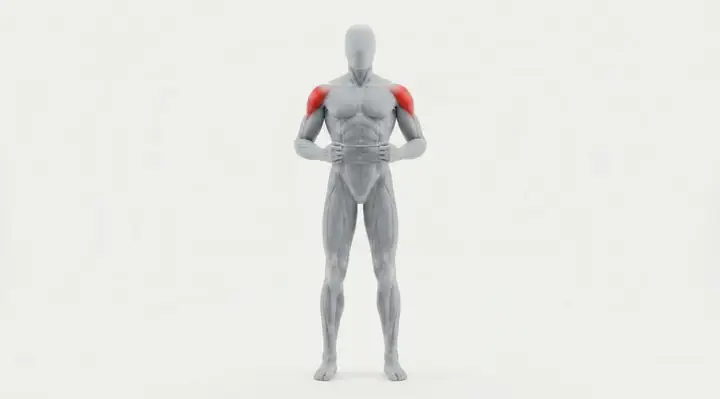 Step 1 You are here
- Band External Rotation
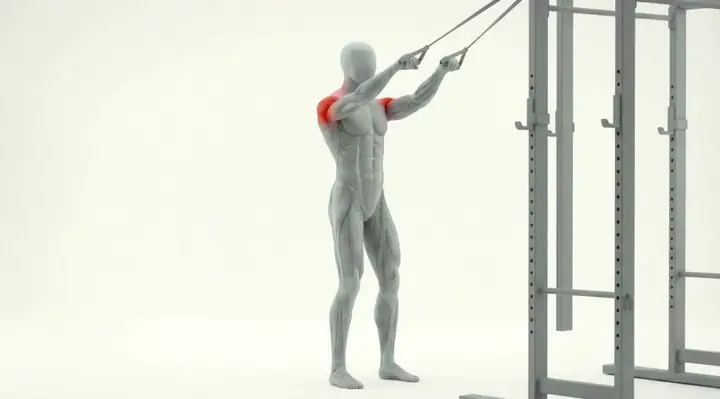
- Cable External Rotation
About the exercise
Band external rotation trains the infraspinatus and teres minor, the two rotator cuff muscles responsible for turning the upper arm outward. The elbow stays tucked against the ribs and bent to roughly ninety degrees while the forearm sweeps away from the midline against band tension. Keeping the elbow fixed is what makes the exercise work, because the moment it drifts the movement becomes a row and the larger back muscles take over. Loads stay deliberately light so the small stabilizers, not the lats, produce the motion.
Updated
Similar exercises
A week of training and meals built for you
Workoutify plans workouts around your days, time and equipment — and a menu for your goal and macros.