Hill Climb Repeats
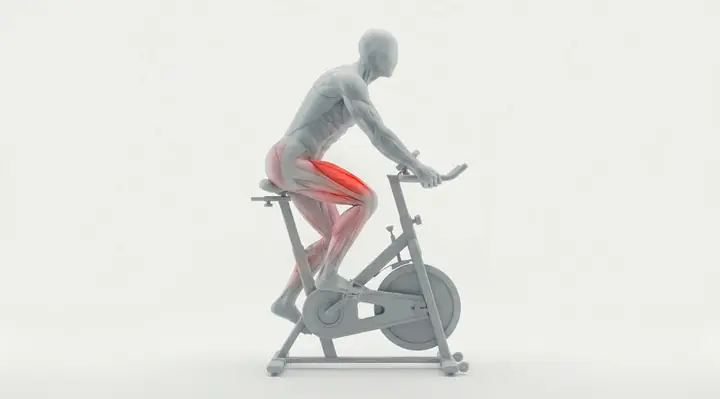
Repeated seated climbing efforts on the bike, holding heavy resistance at low cadence before recovering and going again.
How to do it
- Warm up with easy riding until your legs and breathing are ready to work.
- Choose a grade or resistance heavy enough to pull your cadence down.
- Stay seated with your hips back and your upper body quiet.
- Drive the pedals through the whole circle rather than stamping downward.
- Hold the effort for the planned repeat, then recover on easy resistance.
- Repeat the climb and recovery pattern, then spin easy to finish.
Key technique cue
Stay seated, hips back — don't stand the moment it gets hard.
Common mistakes
- ✕ Standing up as soon as it gets hard, which changes the stimulus of the repeat.
- ✕ Choosing resistance so heavy that form breaks and the knees take the load.
- ✕ Rocking the shoulders side to side, which wastes energy without adding power.
- ✕ Starting the next repeat before output has recovered, so quality falls away.
Benefits
- ✓ Builds pedal force at low cadence without leaving the saddle.
- ✓ Adds a high-demand cycling stimulus that stays low impact.
- ✓ Structures easily into repeatable, measurable training blocks.
Progression: from easier to harder
-
 Step 1
-
 Step 2
-
 Step 3 You are here
- Hill Climb Repeats
- Cycling Intervals
-
 Step 4
About the exercise
Hill repeats replace speed with resistance. Each effort is ridden seated against a grade, so cadence drops, pedal force rises and the quadriceps take a longer, heavier contribution than they do on the flat, with glutes, hamstrings and calves supporting through the stroke. Repeats are structured like any interval set: a fixed effort, then a recovery long enough to restore output before the next one. Climbs are harder to repeat than flat efforts, so rest between repeats matters. It suits structured ride plans and climbing-focused blocks.
Updated
A week of training and meals built for you
Workoutify plans workouts around your days, time and equipment — and a menu for your goal and macros.