Reverse Crunch
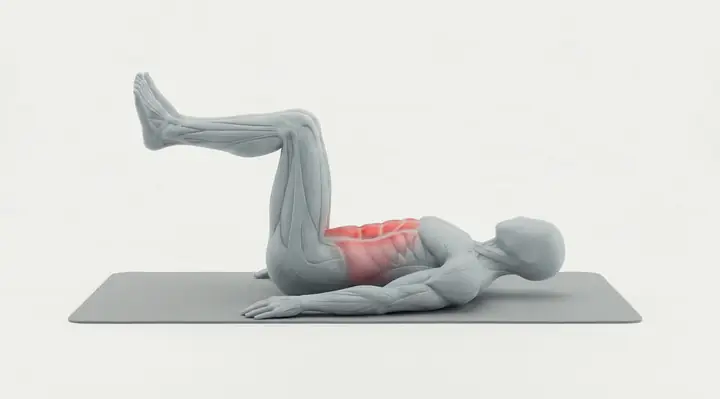
A supine abdominal curl that rolls the hips off the floor and brings the bent knees up and over the chest.
How to do it
- Lie face up on a mat with your arms out to the sides, palms down, for balance.
- Lift your feet and raise the knees until they sit directly over the hips, still bent about ninety degrees.
- Brace the abdominals and press the lower back toward the mat before the first repetition.
- Exhale and roll the hips toward the ribcage so the knees travel toward the head.
- Pause at the top without changing the knee angle or swinging the legs.
- Inhale and lower the hips back until the pelvis and spine rest on the mat, keeping the feet off the floor.
Key technique cue
Roll the pelvis toward the ribs, keep the knee angle fixed; lower with control.
Common mistakes
- ✕ Swinging the legs and riding momentum instead of curling the pelvis with the abdominals.
- ✕ Changing the knee angle during the roll, which turns the drill into a hip-flexor kick.
- ✕ Letting the feet drop to the floor between repetitions, which resets the tension every rep.
- ✕ Dropping the hips back down rather than resisting the descent, which discards the eccentric.
Benefits
- ✓ Trains the abdominals from the pelvis upward, complementing the shoulder-led crunch.
- ✓ Keeps the knees bent and the lever short, so the lower back stays supported.
- ✓ Needs no equipment beyond floor space, so it fits home and travel programming.
Progression: from easier to harder
-
 Step 1 You are here
- Reverse Crunch
-
 Step 2
-
 Step 3
-
 Step 4
About the exercise
The reverse crunch is performed lying face up with the thighs raised over the hips and the knees bent to roughly ninety degrees. Instead of curling the shoulders toward the pelvis, the pelvis curls toward the ribs: the hips roll off the floor as the abdominals shorten and the knees travel up and over the chest. The knee angle stays the same through the roll so the work stays in the trunk rather than in a swing of the legs. Because the knees stay bent the lever is short, and the movement needs nothing but floor space. It sits beside the standard crunch as the pelvis-led half of a bodyweight trunk-flexion pair.
Updated
Similar exercises
A week of training and meals built for you
Workoutify plans workouts around your days, time and equipment — and a menu for your goal and macros.