Machine Lat Pullover
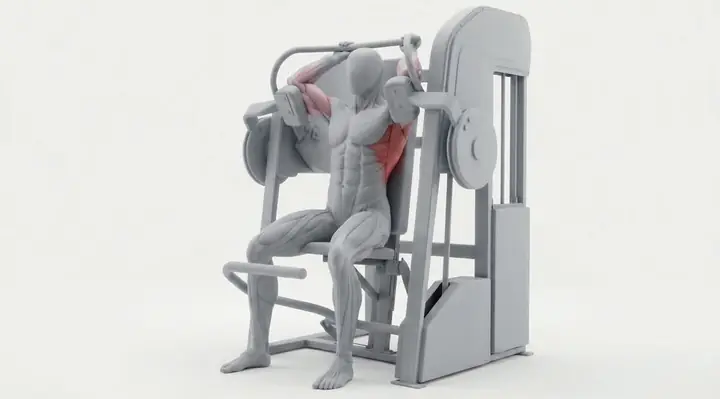
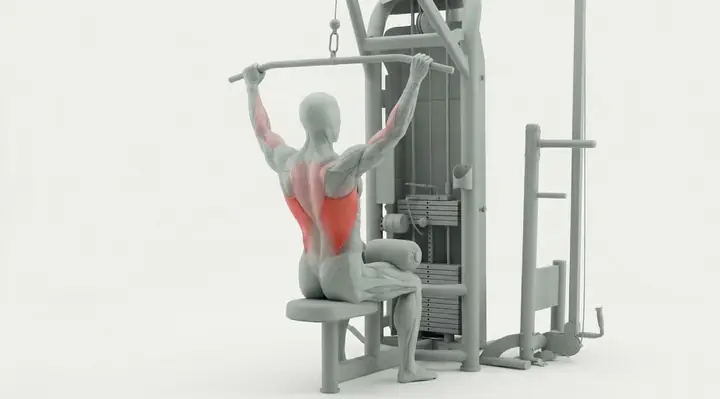
Seated pullover machine that pulls the upper arms down from overhead so the lats work without elbow flexion.
How to do it
- Set the seat so your shoulders line up with the machine's pivot and load the weight.
- Sit down, fasten the seat belt if one is fitted, and press your back into the pad.
- Place your forearms on the pads or take the handles with the elbows bent and fixed.
- Pull your upper arms down and forward in an arc until your elbows reach your ribs.
- Hold the contraction briefly with the shoulder blades depressed.
- Let the arms travel back overhead under control until the lats lengthen, then repeat.
Key technique cue
Keep the elbow angle fixed through the arc, don't force the stretch.
Common mistakes
- ✕ Changing the elbow angle mid-rep turns the pullover into a pressdown and takes the lats out of the movement.
- ✕ Letting the torso lean forward to finish the rep replaces lat work with trunk flexion.
- ✕ Cutting the overhead range short keeps the lats out of the stretched position where most of the stimulus lives.
- ✕ Loading too heavily forces the shoulders past a comfortable overhead range and stresses the joint capsule.
Benefits
- ✓ Trains the lats through shoulder extension with no grip or biceps limitation.
- ✓ Guided arc holds resistance on the back at the overhead stretch, which free weights cannot.
- ✓ Seat belt and back pad remove the trunk stability demand, so load stays on the target muscle.
Progression: from easier to harder
-
 Step 1 You are here
- Machine Lat Pullover
- Band Pullover
- Cable Rope Pullover
About the exercise
The machine lat pullover fixes the forearms against pads or handles and rotates the upper arms from overhead down to the torso. Because the elbow angle barely changes, the latissimus dorsi drives the movement through pure shoulder extension, with the sternal pectorals and the long head of the triceps assisting. Manufacturer documentation for plate-loaded pullover machines describes a deep lat stretch at the start and a full contraction at the finish, and latissimus activity is greatest at lower shoulder elevation angles, so the value sits in controlling the whole arc. It is a back exercise with no grip or biceps limitation. It suits pull-day accessory slots.
Updated
Similar exercises
A week of training and meals built for you
Workoutify plans workouts around your days, time and equipment — and a menu for your goal and macros.