Eccentric Calf Lowers
Step-edge calf raise that lifts with both legs, then slowly lowers the heels below the platform.
How to do it
- Stand on a stable step with the balls of both feet on the edge and the heels free.
- Hold a rail or similar support lightly for balance.
- Rise onto the balls of both feet until the ankles are fully plantarflexed.
- Slowly lower the heels below the level of the step, keeping the knees nearly straight.
- Pause at the bottom stretch, then rise again with both legs.
- Keep the torso upright and do not bounce out of the bottom.
Key technique cue
Lower the heels slowly over three counts — don't drop.
Common mistakes
- ✕ Dropping the heels in a fall instead of controlling the eccentric.
- ✕ Bending the knees so the soleus takes over before the set calls for it.
- ✕ Letting the feet roll onto the outer edges of the step.
- ✕ Pushing off the support with the arms so the calves unload.
Benefits
- ✓ Overloads the calves on the way down, where they can handle more load than on the way up.
- ✓ Uses a step so the heel can travel below standing height.
- ✓ Needs no extra weight, so it fits bodyweight and rehab-adjacent programming.
Progression: from easier to harder
- Step 1
-
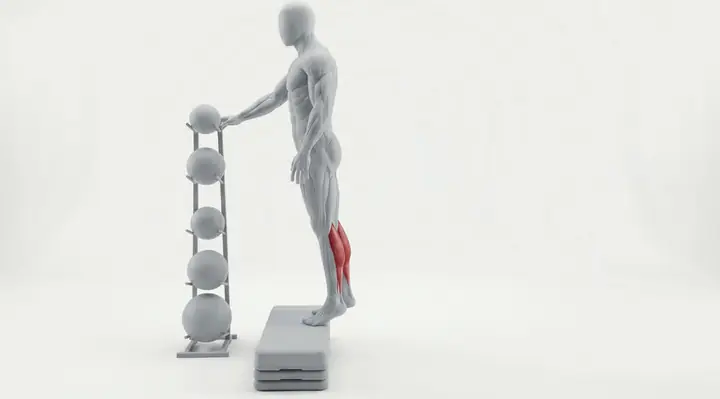 Step 2 You are here
-
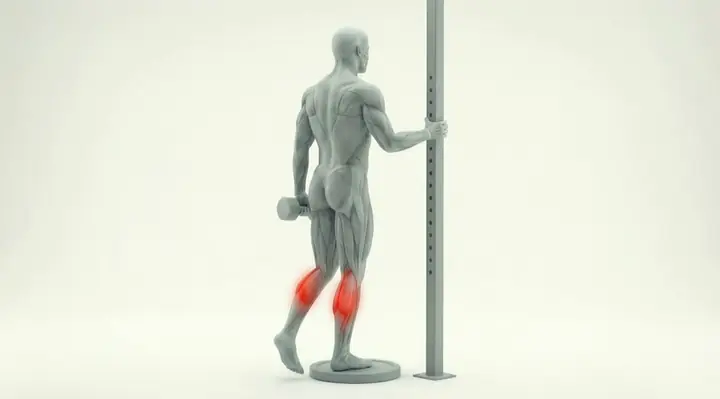 Step 3
About the exercise
Eccentric calf lowers bias the lowering phase of a standing calf raise. Stand on a step, rise onto the balls of both feet, then lower under control, including a single-leg lower when more load is needed. Heel-drop work uses the same step-edge setup: the ball of the foot on the edge, the heel traveling below the platform, with a wall or rail for balance. The gastrocnemius and soleus lengthen as the heel drops, which is why the drill shows up in Achilles loading plans as well as in calf-strength blocks.
Updated
Similar exercises
A week of training and meals built for you
Workoutify plans workouts around your days, time and equipment — and a menu for your goal and macros.